- Auxee AI for Healthcare
- Posts
- From Transactional AI To CFO-Level Intelligence
From Transactional AI To CFO-Level Intelligence
Using RCM data to guide contracts, staffing, and investment decisions.

Dino Gane-Palmer
February 17, 2026

Hi and Happy Tuesday.
In our previous newsletters, we covered Q1 and the rollout of plug-in AI across the revenue cycle and using Q2 to make prior authorization, worklists, posting, and estimates operate as one flow.
This week, we are focused on Q3 and using RCM data to guide contracts, staffing, and investment decisions.
Once eligibility, scrubbing, and workflow automation are working reasonably well, the next question is simple:
Can finance leaders trust RCM data enough to steer strategy with it?
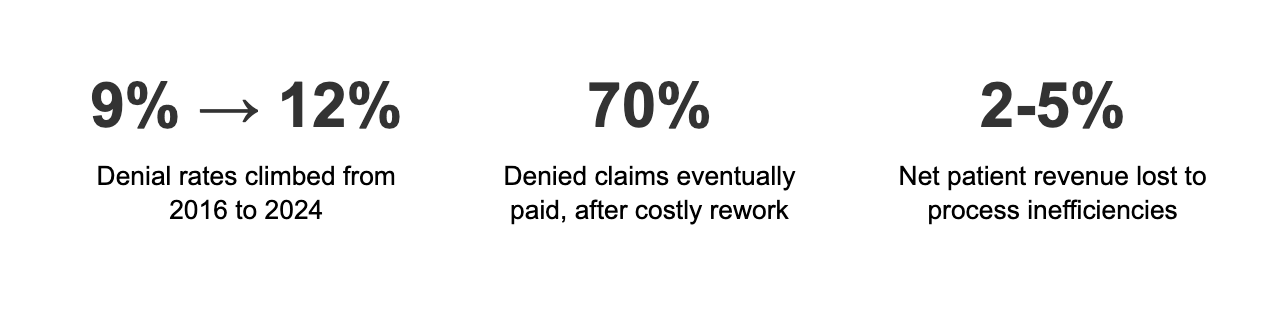
This is the level at which CFOs need enterprise-level intelligence rather than additional line-item reports.
1. System-wide denial root-cause analytics
The limitation:
Most reports stop at denial reason codes. They tell you WHAT happened, not WHY it happened or WHERE to fix it.
2-5% of net revenue lost to preventable denials
Today, many reports stop at denial reason codes. More advanced analytics connect data across scheduling, intake, documentation, coding, and billing to identify patterns such as:
Sites with unusual failure rates for specific services
Clinicians or service lines triggering medical-necessity denials
Workflows where eligibility or authorization failures cluster
Q3 target 1:
Create a unified denial analytics view that ties payer codes back to operational root causes and quantifies dollars at risk by process step.
What this enables:
Target process improvements where they'll have the biggest financial impact
Identify training needs for specific teams or service lines
Prioritize automation investments based on actual dollar leakage
2. Contract and payer-strategy modeling
The market reality
ACA marketplace plans have average denial rates of 19%. Commercial patient collections fell to 34.4% in 2024. Higher contract rates don't guarantee better margins.
~19% In-network denial rate for marketplace plans
34.4% Commercial collection rate drop
AI-driven scenario models are beginning to project how changes in payer mix, contract terms, and policy shifts will affect:
Margin and net collection rate.
Days in A/R and timing of cash.
Staff requirements for denials and appeals.
Q3 target 2:
Build at least one contract model for an upcoming negotiation using your actual denial and collection data, not generic discount assumptions
What this enables:
Enter contract negotiations with data on true net realization
Model the operational cost of different payer relationships
Make strategic decisions about which contracts to pursue or renegotiate
3. Integrated operational planning: RCM plus staffing and capacity
The disconnect
Finance plans volumes. Operations plan staffing. Revenue cycle tracks denials. These conversations happen separately until problems emerge.
71% Of hospitals use predictive AI for operations
66% Of CFOs expanding AI in the revenue cycle
The next evolution: Connect operational models to RCM metrics so staffing decisions account for expected denials, A/R aging, and write-offs.
Projected volumes by service line linked to denial risk
Required staffing and overtime tied to RCM workload
Expected denial and collection performance under different scenarios
Q3 target 3:
Conduct a quarterly planning session where finance, operations, and revenue cycle review a shared model with volumes, staffing, and RCM performance integrated
What this enables:
Make staffing decisions based on forecasted RCM workload
Model how automation investments affect both operations and cash flow
Align finance, operations, and RCM around common projection
Q3 Enterprise Analytics Checkup
Do we have a single denial analytics view that quantifies dollars lost by workflow step, not just by payer and code?
Can we model at least one payer contract using our own denial and collection data rather than generic assumptions?
Can we show CFOs how staffing and automation scenarios change projected margin, days in A/R, and write-offs?
If the answer to any of these is "no" or "not yet,"
That's your Q3 roadmap to CFO-level intelligence.
In our next newsletter, we’ll give you a Q4 roadmap.
Dino Gane-Palmer
 Dino Gane-Palmer | About the Author Dino Gane-Palmer is the founder of Auxee and CEO of PreScouter, an Inc. 5000–recognized innovation consultancy that helps Fortune 500 companies and global organizations capitalize on new markets and emerging technologies. He launched PreScouter while earning his MBA at Kellogg and later founded Auxee to help teams use AI to tackle complex, research-heavy workflows. His work has supported decisions at some of the world’s leading healthcare, manufacturing, and consumer brands. Dino is also the author of the best-selling book Do More With Less: The AI Playbook, a practical guide to applying AI where it matters most. |